It got to midnight last night before I really knew what time it was, and at that point I didn't have time to write a post. Sorry about that. I also had lots to do today, but now I'm done. So this is what's up with yesterday, and there ought to be something up about today's doings later on this evening.
Yesterday: trying to get SDL to work. Lazy Foo says that if I get an error, I probably skipped a step. I double-checked to make sure I didn't skip a step, but I don't know, maybe I'm glossing over the same part each time and then forgetting that I did it. That could also be happening.
I also read the lecture notes for Chapter 2 in TECS. Whooole lotta math in there, glad I had some calculus from my physics days or some of them thar numbars would've really screwed me up. Also, getting a clearer picture of how a computer does so much math so fast.
OK, time to get down to work. Err, play, that is. Hobby? We'll go with hobby. Time to get down to hobby.

Tuesday, March 6, 2012

Sunday, March 4, 2012
New look!
I don't know why I keep going for green, since orange is clearly the color of awesome.
Anyway: Like? Dislike? Suggestions?
Site is easier to read now, which also means easier for me to stare at, and has a search module & tag cloud (which involved tagging all my posts retroactively). Hooray! I accomplished all my weekend site update goals!
Saturday, March 3, 2012
Day 15: Wiki Walking
A Wiki Walk is a train of thought that left the track and is Riding into the Sunset. When going for a Wiki Walk you know where you begin, but no one knows where you'll end. Are you a Mad Scientist building an orbital death ray? Well, too bad, inspiration struck and now it's the world's biggest dancing dish washer with a fully adjustable cup holder. You want to have a serious talk about the Middle East? Within ten minutes you'll be arguing whether Darth Vader could take Gandalf in a fight. Just want to check the Rule Of Cool page? Before you know it you're adding examples to Bungling Inventor. You, my friend, have just had a Wiki Walk.Bit of a late start (that's my King Understatement for today). Well, on writing this entry, at any rate. I've been reading and organizing ideas all evening (more on the ideas later). I'm starting to see the wisdom in the Chinese proverb, "Better to be deprived of food for three days, than tea for one" (and that's from before researchers scientifically established the health benefits).
- TVTropes: Wiki Walk
I finished project 01 in TECS. I'm going to keep posting my progress through the course by chapter and project, because otherwise I'll probably fall off the ball and publicizing my progress increases my commitment to it. But I'm stopping with the "step-by-step herp-a-derp" because it probably won't be helpful to anyone just getting started any more, and so will just amount to cheating for anyone who's actually taking the class. If I am struck by some kind of inspirational tangent, I'll blog about that, but the focus will be on where the tangent ends up and not on the project/chapter itself.
I also poked around quite a bit on LazyFoo.net. This guy's got a load of tutorials ranging from setting up libraries and displaying images to game saves and joysticks, and articles covering topics ranging from the nature of pixels to making a level editor. Like any good neophyte, I'm gradually coming to terms with the fact that the more I learn, the more I'll be able to appreciate just how much I have left to learn. But just as my knowledge of computer systems becomes clearer and more concrete the more I do it, so shall my programming knowledge grow. In this vein, Lazy Foo's page on Nerd Girls: The Game also has a very illuminating (not to mention humbling!) list of "Ten Things About Game Development They Didn't Teach Me in School." I have a feeling I'll be learning a lot from this guy.
So yeah: ideas! I think a happy medium between "game I can start out building" and "game I will have fun playing" is a card-based game. Obviously, I'll have to learn how to code a complete game of Solitaire before I can make my own crazy variation on it, but Solitaire (from what I've read) is a good one to cut your teeth on. We'll worry about the specifics of what would make this more fun to play than any other free version of Solitaire later - y'know, after I've actually made Solitaire and can get a feel for exactly how out-of-control my feature bloat has become. But I spent lots of time between my readings drinking green tea and thinking very explicitly about how to get from A to B one step/feature at a time, and I'm excited to see how it takes shape!
OK, I seriously have to get to bed now. I've got a busy weekend ahead of me, what with the layout stuff I want to do and getting a head start on content for next week. Y'all have a great one!
Thursday, March 1, 2012
Day 14: Eureka!
I took my homework with me this morning when I went to look for work. This was a good decision, because I only had like ten pages left to read in Phantoms in the Brain, and I needed something else to do besides all the paying work the temp agency didn't give me. I had ten more chips to build: DMux, Not16, And16, Or16, Mux16, Or8way, Mux4way16, Mux8way16, DMux4way, and Dmux8way. I built the first six, and half-decided/half-succumbed to saving the last four for when I was able to make sure that the first six actually worked, despite the roll I was on.


Last night, I built a multiplexor by a rather circuitous and wasteful, albeit functionally intact, method. But a two-way multiplexor, using one selector input to choose between two other inputs, only has an eight-value truth table when expressed propositionally. Mux4way, on the other hand, has two selector inputs and four primary inputs (a-d), resulting in a 64-value truth table that still comes out only 1 or 0. Don't even get me started on Mux8way! I realized that yesterday's approach simply wasn't practical, but was stumped as for how to proceed.
Necessity is the mother of invention, and I invented an epiphany. I honestly don't know how I missed this - it must have been decision fatigue - but I realized at some point when trying to draw up the 64 truth values for Mux4way that since it only comes out 1 or 0, I could just express the 1 values as ganged-up And functions, then disjoin them together into a giant Or function! Now I am slightly embarrassed over yesterday's fiddle-fartin'; but that's what I get for doing my homework in public. More importantly, I learned a valuable lesson, and I'm proud for having solved the problem in a more elegant fashion anyway, so it's all good. Behold: Mux2.0!

Meaner. Leaner. Also greener!
And here's the new and improved NAnd-Only HDL:
IN a, b, sel;
OUT out;
PARTS:
Nand (a=sel, b=sel, out=NotS);
Nand (a=a, b=NotS, out=r1);
Nand (a=sel, b=b, out=r2);
Nand (a=r1, b=r2, out=out);
Wham! Bam! Flim and flam! That's over 75% fewer lines of functional code, for those of you playing along at home. My inner quality consultant is serenely satisfied. OK, moving on!
DMux, the demultiplexor which takes a single input and uses a switch between two outputs, gave me a little bit of trouble. But that was only because I was thinking I still had one output, when actually I've got two output pins coming out of my own little black box space. That realization cleared it up right quick! The diagram seems almost absurdly simple in hindsight - even the NAnd-Only diagram!

Gallons easier once you paradigm shift out of truth-functional
propositions per se and just start black-boxing everything.
I'm not even going to bother with the code, here. If you've been following, it's simple enough to work it out for yourself, and I'm starting to feel pangs of "give a man a fish" guilt about doing this all in public. At this point, though, I think the only "damage" I've done is to help along somebody just getting started, like I am. That said, my code works beautifully! (Also, I found via typo that this HDL is case sensitive - good to know!)
Next up, Not16: the first 16-bit gate. This is the reason I wanted to try out a proof-of-concept at home before actually diagramming and coding Mux4way16 and the rest. Turns out, I can't just put in the variable "i" for inputs 0-15, I have to code them line-by-line. Or I could type it once in Word, and use Replace! Not a big deal for Not16, but definitely going to appreciate it for Mux8way16! I have never been so grateful for Ctrl+H in my life (true story!). I can imagine a program that takes code with [i] as a variable, expands it n times, and replaces [i] in each iteration of the code with [n-1] (because you start with zero, duh)... but this would save me a fairly minor amount of time (even though it feels like a lot of tedium), and anyway if I knew how to do that, I wouldn't be doing this in the first place. Heh. Whatever, Ctrl+V x 16 and highlighting a few lines then pressing Ctrl+H, Tab, n-1, Alt-A, N, Esc over and over isn't exactly hard. So that's And16, Or16, and Mux16 out of the way.
Or8way throws a bit of a curve, since it's not mapping multiple inputs to multiple outputs like the last three chips. Instead, we're taking in eight inputs to the same giant Or function which maps to a single output. What we're coding here is not to do one thing with many inputs and outputs, but rather to check for any of eight things (rather than Or's mere two). Here I think it pays to point out that how we code this may have an appreciable effect on performance: I could code 4+2+1 (or 8-1, ganging them serially rather than pairing them) Or gates, making the machine instantiate the Or chip (and its 3 component NAnd gates) seven times "inside" this chip; or I could directly code all 7*3 NAnd gates and have it be its own thing rather than making the machine look elsewhere first. While the difference between configurations is infinitesimal for just this one Or8 gate, it adds up cumulatively in the processor load when turn on the "computer" and run the "chips." Not of particular importance to the lesson at hand, but of tangential relevance and so I thought I'd point it out.
Also, I found out by experience that pins cannot be named beginning with numbers - who knew? I named the outputs from some of my NAnd gates as "out=xvy" for clarity (where x and y were integer values corresponding to input pins), rather than the relatively nondescript r1/r2, etc. I kept getting the error, "A pin name is expected," and jiggered around with it for over half an hour, giving myself a headache in the process. I have a feeling I should be expecting a lot of these in the weeks and months to come...
Taking stock: I seriously refined my multiplexor, which is a big deal to me, and wrote up the first six of my final ten gates. Good progress for one day, I think; and my brain is feeling full now, to boot! I also watched a great introductory video over at the Khan Academy, during which an idea for a text adventure began crystallizing. I'm not sure quite how to do the "window" stuff yet, but I've got a good handle on how to declare values like player health, experience, and level, and how to nest conditional dependencies inside them to link derived stats to their primaries (now I just need, oh, the rest of a game to house them!). I've also got some good ideas for a weekend mini-project to overhaul the site with a custom image header and a few layout features, so there's quite a bit going on under the hood today, as well. Plus Zach gave me another tip for making forward progress on Fetris, so I'll be looking into that right now. Y'all have a great one!
Final Thought: I just realized while proofreading that the program I pined after above - the one that would do my homework for me - would actually be pretty easy to code using the principles taught in Python by that video at the Khan Academy. The only real "invention" would be to code the recursive function that iterates the steps n times. Great, now I'm going to be thinking about that all night. Anyway, I'm not writing the code here, since that would be providing a tool that actually does actual homework in an actual class, but the principle will be super-useful when generating content procedurally in future games.
Wednesday, February 29, 2012
Day 13: TECS, Chapter 1, Part 2.
Zach gave me a suggestion that I thought would work. After half an hour of Googling, it still did not work. Back to the books!
I picked up exactly where I left off, on the testing scripts. Here is a test script from the textbook (testing the Xor gate which I discussed yesterday):
Next is what the chips are and how to build them. Easy-peasy, quick an' breezy. Well, up until we get to the 4-way 16-bit multiplexor, anyway. The Alert Reader will recall that multiplexors gave me a small headache yesterday, but today I only got slightly narrowed eyes and increased attention. Demultiplexors were a cinch after that; it's just the same thing, backwards! Building these exclusively out of NAnd gates? Ehh, not so much.

But that's the end of the chapter! Now for the project: build all the chips/gates mentioned in the chapter out of NAnd only (that would be Not, And, Or, Xor, Mux, DMux, Not16, And16, Or16, Mux16, Or8way, Mux4way16, Mux8way16, DMux4way, DMux8way). If this were a real course, I'd have a week to do this, so let's see how I feel after doing Not, And, Or, Xor, and Mux. Then I'll sleep on it and try the rest tomorrow.
Ready? Go!
First up, Not via NAND. Easy enough, right?
IN in;
OUT out;
PARTS:
Nand(a=in, b=in, out=out);
Ha ha, NAnd already does the heavy lifting for me! Load the test script, and: SUCCESS! Now for And via NAnd. Whoah, I almost thought I could just put a Not at the end, but herp-a-derp, that wouldn't work because NAnd isn't the... Wait. No, that's exactly what I want!
IN a, b;
OUT out;
PARTS:
Nand(a=a, b=b, out=r1) //the R is for RESULT, get it?
Not(in=r1, out=out); //let's make it more explicit, shall we?
Nand(a=r1, b=r1, out=out);
Load the test script, make sure I didn't do anything stupid, and... SUCCESS! I'm on a fuckin' roll! Now for the inclusive Or. This will require gymnastics...wait, no it won't, because I can just put Nots after a & b before they go into NAND, and poof! Let's be super explicit again:
IN a, b;
OUT out;
PARTS:
Nand(a=a, b=a, out=nota);
Nand(a=b, b=b, out=notb);
Nand(a=nota, b=notb, out=out);
Too sexy, too sexy! This is going smoothly. Now, I can't help cheating for Xor, since I was already given a diagram and the HDL for it; what I can help is whether I cheat further by simply copying, or instead translate the existing HDL into Super-Exciting Mega-Explicit NAnd-Only Language! (I'm not shouting, the "!" is just part of the phrase.) The tough part here is now no longer coming up with the HDL, but keeping my terms straight. I'll make a new diagram and divide it up into three phases like the old one: the Not phase, the And phase, and the Or phase, finally leading to the output. Here it is:

IN a, b;
OUT out;
PARTS:
Nand(a=a, b=a, out=nota);
Nand(a=b, b=b, out=notb);
Nand(a=a, b=notb, out=r1);
Nand(a=nota, b=b, out=r2);
Nand(a=r1, b=r2, out=out);
Instead of crossing my fingers, I'ma crack my knuckles. Crackita-pop! Plow! Annnd... SUCCESS! In the same number of lines of code as their original Xor gate, which needed Not, And, and Or! HOO-HA!
Uh-oh. Now for Mux. OK, there's a reason I decided to make this the last one for the night, and it's not just that it's 10:22. You're on a roll, just keep it going, man. Think out loud. Or on paper. Erm, in type. Whatever. You've got your a in, your b in, and your selector, and the selector decides which input comes through. I can do this. Think of it in terms of the shortcuts, first. Then blow it up into NAnd-Only, then simplify (if you can). OK.
Dammit, now it's 10:42, and I've been staring at this for 20 minutes and thinking, "No, this won't work. No, that won't work. Shit, what am I gonna do?" Urge... to cheat... rising... WAIT. Re-draw the truth table so it's less confusing. OK, now it looks like an Or for a & sel when sel=0, and it looks like an And for b & sel when sel=1. Good, you can work with this. Keep going. All right, it can't trigger the And for b & sel when sel=0, so... run an And from sel & b (result: selAndb). Duh. Keep going. Run an Or from sel & a (result: selOra). Now we've got selAndb which gives b when sel=1 and 0 when sel=0; and we've got selOra which gives 1 when sel=1 and a when sel=0. Good. Paragraph break.
Now compare your "mini" truth tables with each other. Wait. Duh. You're barking up the wrong tree here. Stop trying to make it explicitly perform based on why you know it ought to go, and make it perform based on why it needs to go. Back up and brute force the fucker, then clean it up in post. You'll be fine. OK. Start with sel&a&b=1. Work up from there. Run them all to And gates, then make those come out how they ought to do. Then funnel them into bottlenecks so that you get what you need at the end.
OK, finally. I got it. It's 11:50, and I fucking got it. First, I just did everything in terms of "and," "not," and "output" - not HDL-wise, just logic-wise. Like, I wrote on a piece of paper:
s&a&b=1
s&a&~b=0
s&~a&b=1
...and so on. Then I drew up HDL-like parsings of those functions, and tried to make them as similar as possible. I noticed that I could capture three correct outputs with only (s*a)*b (call it x), four more with (s+a)*b (call it y), and the last one with (s+a)*~b (call it z). (For the uninitiated, + = or, * = and, ~ = not.) Then I drew up a truth table for s, a, b across from x, y, z, and also drew up the output. I noticed that y predicted three of four outputs of 1, and z got the other one when s=0. The x function was useless, so I discarded it, and made x': y+(z*~s). (Fun Fact: I accomplished this step by folding over the s/a/b section, MAD Magazine fold-in style! Now that's thinking outside the box!) Finally, I drew up a schematic for a, b, and s inputs, into y and z functions using And, Or, and Not gates, then put it all through to the x' function, and that gives the output. So we have:
IN a, b, sel;
OUT out;
PARTS:
Or (a=a, b=sel, out=sva);
And (a=sva, b=b, out=y); //these lines describe the y function
Not (in=b, out=notb);
And (a=sva, b=notb, out=z); //these lines describe the z function, and I can re-use sva from above
Not (in=sel, out=nots);
And (a=z, b=nots, out=zAndNots);
Or (a=y, b=zAndNots, out=out); //these three lines describe the x' function, which is just output
OK, let's see if that runs... SUCCESS! Holy carp, that was insane. OK, that's my proof of concept, now to break it down into NAnd-Only. Picture first? Picture first!

IN a, b, sel;
OUT out;
PARTS:
Nand (a=a, b=a, out=nota);
Nand (a=sel, b=sel, out=nots);
Nand (a=nota, b=nots, out=sva);
Nand (a=sva, b=b, out=r1);
Nand (a=r1, b=r1, out=y); //BAM! That's y, now for z.
Nand (a=b, b=b, out=notb);
Nand (a=sva, b=notb, out=r2);
Nand (a=r2, b=r2, out=z); //Sweet. Now to wrap it all up!
Nand (a=z, b=nots, out=r3);
Nand (a=r3, b=r3, out=zAndNots);
Nand (a=y, b=y, out=noty);
Nand (a=zAndNots, b=zAndNots, out=notzAndNots);
Nand (a=noty, b=notzAndNots, out=out); //done!
Plug & chug, and... BAM! Success on the first try! And it only took me - TWO AND A HALF HOURS?! Whatever, I'm done now. By the stars, I've got a lot to do tomorrow, though... I'm starting to see why hardware designers burn out and how programming conventions become insane.
I picked up exactly where I left off, on the testing scripts. Here is a test script from the textbook (testing the Xor gate which I discussed yesterday):
load Xor.hdl,output-list a, b, out;Oh, man. This is easy, after understanding the chip itself! Just load up the chip, specify what goes onto the output list (in this case, our values for a, b, and the evaluated outputs), then set a & b to all combinations they could be, evaluate the chip's function, and output it. Like unto a pie. Sure enough, we get:
set a 0, set b 0,
eval, output;
set a 0, set b 1,
eval, output;
set a 1, set b 0,
eval, output;
set a 1, set b 1,
eval, output;
a | b | outHot cha. What's next?
0 | 0 | 0
0 | 1 | 1
1 | 0 | 1
1 | 1 | 0
Next is what the chips are and how to build them. Easy-peasy, quick an' breezy. Well, up until we get to the 4-way 16-bit multiplexor, anyway. The Alert Reader will recall that multiplexors gave me a small headache yesterday, but today I only got slightly narrowed eyes and increased attention. Demultiplexors were a cinch after that; it's just the same thing, backwards! Building these exclusively out of NAnd gates? Ehh, not so much.
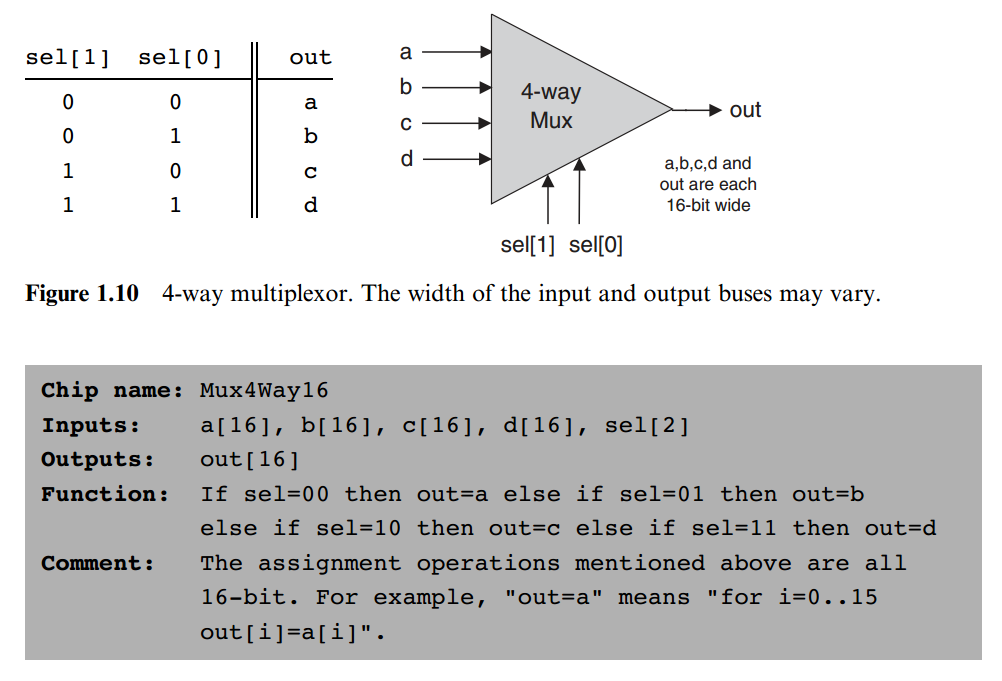
I just learned this yesterday. Now you want me to build it with
two pop tabs and a paperclip? CHALLENGE ACCEPTED.
(From The Elements of Computing Systems, by Noam Nisan & Shimon Schocker)
But that's the end of the chapter! Now for the project: build all the chips/gates mentioned in the chapter out of NAnd only (that would be Not, And, Or, Xor, Mux, DMux, Not16, And16, Or16, Mux16, Or8way, Mux4way16, Mux8way16, DMux4way, DMux8way). If this were a real course, I'd have a week to do this, so let's see how I feel after doing Not, And, Or, Xor, and Mux. Then I'll sleep on it and try the rest tomorrow.
Ready? Go!
First up, Not via NAND. Easy enough, right?
IN in;
OUT out;
PARTS:
Nand(a=in, b=in, out=out);
Ha ha, NAnd already does the heavy lifting for me! Load the test script, and: SUCCESS! Now for And via NAnd. Whoah, I almost thought I could just put a Not at the end, but herp-a-derp, that wouldn't work because NAnd isn't the... Wait. No, that's exactly what I want!
IN a, b;
OUT out;
PARTS:
Nand(a=a, b=b, out=r1) //the R is for RESULT, get it?
Nand(a=r1, b=r1, out=out);
Load the test script, make sure I didn't do anything stupid, and... SUCCESS! I'm on a fuckin' roll! Now for the inclusive Or. This will require gymnastics...wait, no it won't, because I can just put Nots after a & b before they go into NAND, and poof! Let's be super explicit again:
IN a, b;
OUT out;
PARTS:
Nand(a=a, b=a, out=nota);
Nand(a=b, b=b, out=notb);
Nand(a=nota, b=notb, out=out);
Too sexy, too sexy! This is going smoothly. Now, I can't help cheating for Xor, since I was already given a diagram and the HDL for it; what I can help is whether I cheat further by simply copying, or instead translate the existing HDL into Super-Exciting Mega-Explicit NAnd-Only Language! (I'm not shouting, the "!" is just part of the phrase.) The tough part here is now no longer coming up with the HDL, but keeping my terms straight. I'll make a new diagram and divide it up into three phases like the old one: the Not phase, the And phase, and the Or phase, finally leading to the output. Here it is:
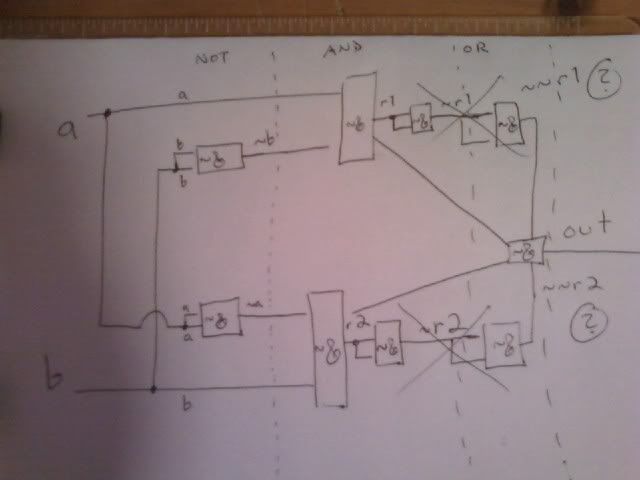
I haven't felt this enlightened since I learned why
the square root of two is necessarily irrational.
Hey, r1 & r2 just get Not'ed twice - at the end of the And phase, and at the beginning of the Or phase - which means... carry the one... I can skip steps. As long as I skip the right ones. Now I'm actually learning! Doing that, my new Optimized NAnd-Only Xor HDL is:IN a, b;
OUT out;
PARTS:
Nand(a=a, b=a, out=nota);
Nand(a=b, b=b, out=notb);
Nand(a=a, b=notb, out=r1);
Nand(a=nota, b=b, out=r2);
Nand(a=r1, b=r2, out=out);
Instead of crossing my fingers, I'ma crack my knuckles. Crackita-pop! Plow! Annnd... SUCCESS! In the same number of lines of code as their original Xor gate, which needed Not, And, and Or! HOO-HA!
Uh-oh. Now for Mux. OK, there's a reason I decided to make this the last one for the night, and it's not just that it's 10:22. You're on a roll, just keep it going, man. Think out loud. Or on paper. Erm, in type. Whatever. You've got your a in, your b in, and your selector, and the selector decides which input comes through. I can do this. Think of it in terms of the shortcuts, first. Then blow it up into NAnd-Only, then simplify (if you can). OK.
Dammit, now it's 10:42, and I've been staring at this for 20 minutes and thinking, "No, this won't work. No, that won't work. Shit, what am I gonna do?" Urge... to cheat... rising... WAIT. Re-draw the truth table so it's less confusing. OK, now it looks like an Or for a & sel when sel=0, and it looks like an And for b & sel when sel=1. Good, you can work with this. Keep going. All right, it can't trigger the And for b & sel when sel=0, so... run an And from sel & b (result: selAndb). Duh. Keep going. Run an Or from sel & a (result: selOra). Now we've got selAndb which gives b when sel=1 and 0 when sel=0; and we've got selOra which gives 1 when sel=1 and a when sel=0. Good. Paragraph break.
Now compare your "mini" truth tables with each other. Wait. Duh. You're barking up the wrong tree here. Stop trying to make it explicitly perform based on why you know it ought to go, and make it perform based on why it needs to go. Back up and brute force the fucker, then clean it up in post. You'll be fine. OK. Start with sel&a&b=1. Work up from there. Run them all to And gates, then make those come out how they ought to do. Then funnel them into bottlenecks so that you get what you need at the end.
OK, finally. I got it. It's 11:50, and I fucking got it. First, I just did everything in terms of "and," "not," and "output" - not HDL-wise, just logic-wise. Like, I wrote on a piece of paper:
s&a&b=1
s&a&~b=0
s&~a&b=1
...and so on. Then I drew up HDL-like parsings of those functions, and tried to make them as similar as possible. I noticed that I could capture three correct outputs with only (s*a)*b (call it x), four more with (s+a)*b (call it y), and the last one with (s+a)*~b (call it z). (For the uninitiated, + = or, * = and, ~ = not.) Then I drew up a truth table for s, a, b across from x, y, z, and also drew up the output. I noticed that y predicted three of four outputs of 1, and z got the other one when s=0. The x function was useless, so I discarded it, and made x': y+(z*~s). (Fun Fact: I accomplished this step by folding over the s/a/b section, MAD Magazine fold-in style! Now that's thinking outside the box!) Finally, I drew up a schematic for a, b, and s inputs, into y and z functions using And, Or, and Not gates, then put it all through to the x' function, and that gives the output. So we have:
IN a, b, sel;
OUT out;
PARTS:
Or (a=a, b=sel, out=sva);
And (a=sva, b=b, out=y); //these lines describe the y function
Not (in=b, out=notb);
And (a=sva, b=notb, out=z); //these lines describe the z function, and I can re-use sva from above
Not (in=sel, out=nots);
And (a=z, b=nots, out=zAndNots);
Or (a=y, b=zAndNots, out=out); //these three lines describe the x' function, which is just output
OK, let's see if that runs... SUCCESS! Holy carp, that was insane. OK, that's my proof of concept, now to break it down into NAnd-Only. Picture first? Picture first!
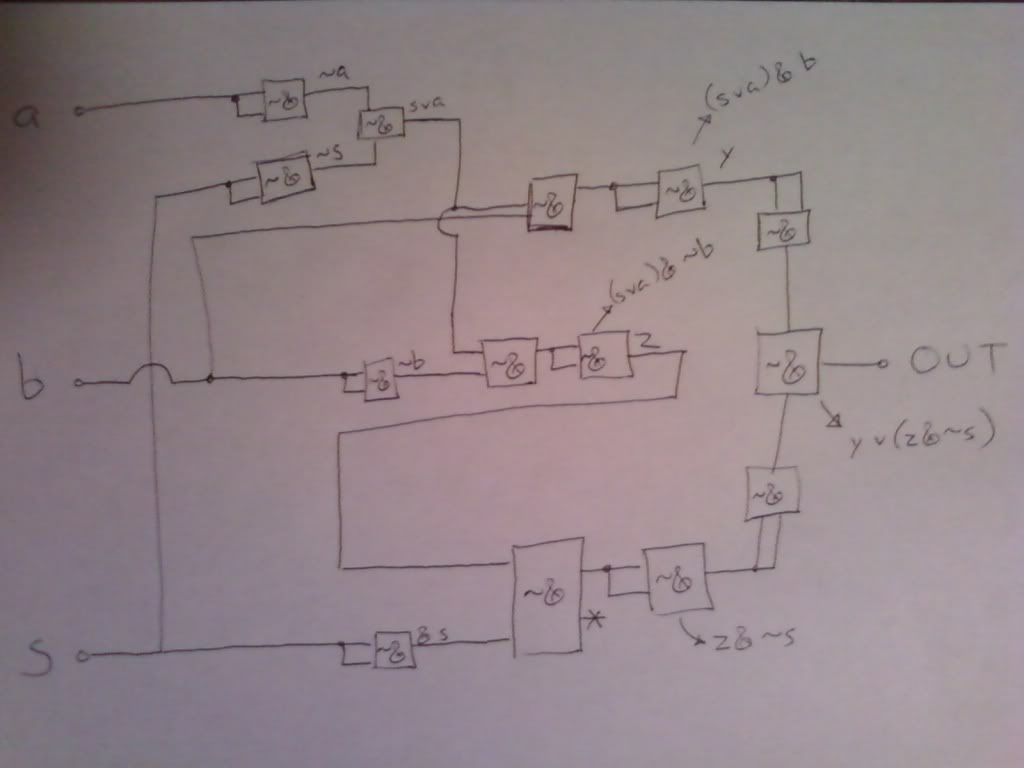
And to think, this is still the easy part...
Whoops, that "&s" at the bottom coming out of the first NAnd should read "~s"; and I need to label some results r1, r2, and r3; and I should also label that bit that comes out notzAndNots when you come anticlockwise around the lower-right corner. Not taking another picture, though. Now for code:IN a, b, sel;
OUT out;
PARTS:
Nand (a=a, b=a, out=nota);
Nand (a=sel, b=sel, out=nots);
Nand (a=nota, b=nots, out=sva);
Nand (a=sva, b=b, out=r1);
Nand (a=r1, b=r1, out=y); //BAM! That's y, now for z.
Nand (a=b, b=b, out=notb);
Nand (a=sva, b=notb, out=r2);
Nand (a=r2, b=r2, out=z); //Sweet. Now to wrap it all up!
Nand (a=z, b=nots, out=r3);
Nand (a=r3, b=r3, out=zAndNots);
Nand (a=y, b=y, out=noty);
Nand (a=zAndNots, b=zAndNots, out=notzAndNots);
Nand (a=noty, b=notzAndNots, out=out); //done!
Plug & chug, and... BAM! Success on the first try! And it only took me - TWO AND A HALF HOURS?! Whatever, I'm done now. By the stars, I've got a lot to do tomorrow, though... I'm starting to see why hardware designers burn out and how programming conventions become insane.
Tuesday, February 28, 2012
Day 12: Poking around the internets.
Zach left a helpful link in a comment on yesterday's post, and after reading through the whole thing, I have a slightly clearer idea of what's going wrong. See, line 187 says:
I don't know how to fix that, though. Either I need to do something different in the WinMain function (which I'm not sure what that would be), or I need to change my definition up at the top (and I'm not sure how I ought to do that). Well, this is what I get for using someone's code from over eight years ago. And holy carp, I spent over half an hour just typing out the above. Well, more like five minutes typing and revising it, and 25 minutes cradling my head trying to sort everything out. This is in addition to the hour I spent poking and prodding and reading and trying to make it work. And I'm still probably missing something (like a real programming course). Fine.
I'm going to play around with that NAND to Tetris thing.
Got the hardware simulator running after installing the 64-bit version of Java (had to consult their forums to find out I needed to do that - apparently the version I had before wasn't good enough). Got the Hardware Simulator running, and figured out how to load and test gates/chips in it. Nice. Project 00 complete, on to Chapter 1!
I started flipping through the slides for the lecture, figuring I'd read the chapter after I got an idea of what I'll be learning. Right away, multiplexers stumped me (well, on slide 9 of 24, anyway). I could not for the life of me figure out what was going on in that truth table. Wikipedia to the rescue! (By the way, is Wikipedia being wonky for anyone else lately?) Man, multiplexers are easy once you know that the selector picks which input gets to be translated into output! (I did not know that more than five minutes ago.) The rest of the slide show was easy after that - but now I have to basically re-learn all of my logic using NAND only, which is doable, but confusing. Whatever, that's the point of the exercise.
Reading the chapter itself, I further learned what the "canonical representation" of a Boolean function is (it's the inclusive disjunction of all the possible values which yield "true" on the truth table). I've also got the hardware description language (HDL) down. See, twenty minutes ago, this was gibberish to me:
OK, I've been doing this for hours, I'm halfway through the first chapter, and this is like a week's worth of work anyway. My brain is full. G'night, everybody!
wcx.lpszClassName=WINDOWCLASS;...and the error returned is:
error C2440: '=' : cannot convert from 'const char [7]' to 'LPCWSTR'So, OK, at least that's not gibberish to me any more. And way, way back up in line 15, when I wrote:
1> Types pointed to are unrelated; conversion requires reinterpret_cast, C-style cast or function-style cast
#define WINDOWCLASS "Fetris"...that must have made "WINDOWCLASS" into a constant. OK. And on line 187, I'm not certain what that "wcx" bit is all about, but "lpsz" means that I'm setting a long pointer to a null-terminated string - so it wants ASCII. Right? But... if it's trying to use a long pointer to a constant wide string... that means it wants Unicode. So I'm telling the machine to do something with ASCII, and it's trying to do it in Unicode, and that's the problem? I think so.
I don't know how to fix that, though. Either I need to do something different in the WinMain function (which I'm not sure what that would be), or I need to change my definition up at the top (and I'm not sure how I ought to do that). Well, this is what I get for using someone's code from over eight years ago. And holy carp, I spent over half an hour just typing out the above. Well, more like five minutes typing and revising it, and 25 minutes cradling my head trying to sort everything out. This is in addition to the hour I spent poking and prodding and reading and trying to make it work. And I'm still probably missing something (like a real programming course). Fine.
I'm going to play around with that NAND to Tetris thing.
Got the hardware simulator running after installing the 64-bit version of Java (had to consult their forums to find out I needed to do that - apparently the version I had before wasn't good enough). Got the Hardware Simulator running, and figured out how to load and test gates/chips in it. Nice. Project 00 complete, on to Chapter 1!
I started flipping through the slides for the lecture, figuring I'd read the chapter after I got an idea of what I'll be learning. Right away, multiplexers stumped me (well, on slide 9 of 24, anyway). I could not for the life of me figure out what was going on in that truth table. Wikipedia to the rescue! (By the way, is Wikipedia being wonky for anyone else lately?) Man, multiplexers are easy once you know that the selector picks which input gets to be translated into output! (I did not know that more than five minutes ago.) The rest of the slide show was easy after that - but now I have to basically re-learn all of my logic using NAND only, which is doable, but confusing. Whatever, that's the point of the exercise.
Reading the chapter itself, I further learned what the "canonical representation" of a Boolean function is (it's the inclusive disjunction of all the possible values which yield "true" on the truth table). I've also got the hardware description language (HDL) down. See, twenty minutes ago, this was gibberish to me:
/* Xor (exclusive or) gate:If a<>b out=1 else out=0. */But now I get it! See:
CHIP Xor {
IN a, b;
OUT out;
PARTS:
Not(in=a, out=nota);
Not(in=b, out=notb);
And(a=a, b=notb, out=w1);
And(a=nota, b=b, out=w2);
Or(a=w1, b=w2, out=out);
}
/* Xor (exclusive or) gate:I feel smarter already!
If a<>b out=1 else out=0. */
CHIP Xor { //we have a chip, called "Xor"
IN a, b; // it has inputs "a" and "b"
OUT out; // it has output "out"
PARTS: // these are its parts
Not(in=a, out=nota); // A "not" gate with input from a, outputting to "nota"
Not(in=b, out=notb); // A "not" gate with input from b, outputting to "notb"
And(a=a, b=notb, out=w1); // An "and" gate with input from a and notb, outputting to "w1"
And(a=nota, b=b, out=w2); // An "and" gate with input from nota and b, outputting to "w2"
Or(a=w1, b=w2, out=out); // An "or" gate with input from w1 and w2, outputting to "out"
}
OK, I've been doing this for hours, I'm halfway through the first chapter, and this is like a week's worth of work anyway. My brain is full. G'night, everybody!
Monday, February 27, 2012
Day 11: Fetris bug-huntin'.
Before I dive into the "actual" errors, I decided to fix the "pretend" errors (i.e. the errors caused by my human error, like typos). In addition to the errors I found last week, I found one case of necessary capitalization, one case of extra comma (which caused three other syntax errors in the same line), one case of super-exciting extra "}", and one case of a comma that should'a been a semicolon.
I take solace in the fact that I was able to solve my own syntax errors (which were the larger portion of the errors generated) simply by looking at them. I said, "Oh, that's obviously what's causing the problem," attempted to compile it once again, and BAM! Error gone! There was one case where I put a 1 (one) instead of an l (lower-case L), but... look, they look the same. I would say to them, "You want an ice cream cone?" Both of them say, "Yes." Everything that got more complicated than that, I checked against the original post, and yeah: did it exactly like he said (except for the one part where I kinda-sorta skipped a line).
I am unlikely to get support from Evil_Greven himself on this, but that's OK. It wouldn't be a learning experience without like six bajillion hurdles. My high school chemistry teacher, Dr. Landorf, once gave us a universal problem-solving method. I forget most of it, but the two parts that stuck with me were: "A problem is not when you simply have to get from A to B. A problem is when you have to get from A to B and have no idea how. Otherwise you merely have a number crunch," and, "When you can't find the solution to a problem, start at the answer and derive the question." I couldn't find the list itself on the internet (this was a handout from before the internet was everywhere, and apparently drew from several sources), but I did find a really great joke while I was looking:
OK, so the guy in thread number two said that I could either switch the compiler settings to multibyte character set, or use unicode strings instead (the recommended option). I can't find that option after combing through them all, and I don't know how to make it unicode compliant quite yet, so I'm calling it a night. It's quarter after ten, I have learned some things and done some things, and I'm happy.
For now.
I am unlikely to get support from Evil_Greven himself on this, but that's OK. It wouldn't be a learning experience without like six bajillion hurdles. My high school chemistry teacher, Dr. Landorf, once gave us a universal problem-solving method. I forget most of it, but the two parts that stuck with me were: "A problem is not when you simply have to get from A to B. A problem is when you have to get from A to B and have no idea how. Otherwise you merely have a number crunch," and, "When you can't find the solution to a problem, start at the answer and derive the question." I couldn't find the list itself on the internet (this was a handout from before the internet was everywhere, and apparently drew from several sources), but I did find a really great joke while I was looking:
A mechanical engineer, an electrical engineer, and a software engineer are in a car that breaks down. The mechanical engineer says, "Maybe is's a stuck valve." The electical engineer says, "Maybe it's a dead battery." The software engineer says, "I know. Let's all get out and get back in again, and see if that fixes it."BWAHAHA! Oh, what a groaner! Love it! OK, so I've now got it down to three errors:
1>------ Build started: Project: Fetris, Configuration: Debug Win32 ------Much more manageable than the two dozen I had on Friday. I can handle this. I think. I Googled the first error, in accordance with the prophecy (the prophecy is "JFGI") and found this thread, which led me to this other thread., which led me to this excellent article. The article is called "Making Wrong Code Look Wrong," and the author goes on about the true history of Hungarian notation (which I did not know was a thing until today) and how to be your own best friend with your programming conventions. Since one of my errors from this very day was an extra "}" nestled amongst some 50 lines of nested "how to make teh bloxxxorz," I really wish that Evil_Greven had followed rule 5: "Don't put closing braces more than one screen away from the matching opening brace." It would've been gallons easier to spot that extra brace, had he done so. But no worries! I learned a valuable lesson. And I bookmarked that guy's blog, because it's rad as Hell.
1> main.cpp
1>c:\users\d\documents\visual studio 2010\projects\fetris\fetris\main.cpp(187): error C2440: '=' : cannot convert from 'const char [7]' to 'LPCWSTR'
1> Types pointed to are unrelated; conversion requires reinterpret_cast, C-style cast or function-style cast
1>c:\users\d\documents\visual studio 2010\projects\fetris\fetris\main.cpp(196): error C2664: 'CreateWindowExW' : cannot convert parameter 2 from 'const char [7]' to 'LPCWSTR'
1> Types pointed to are unrelated; conversion requires reinterpret_cast, C-style cast or function-style cast
1>c:\users\d\documents\visual studio 2010\projects\fetris\fetris\main.cpp(260): error C2664: 'BitMapObject::Load' : cannot convert parameter 2 from 'const char [11]' to 'LPCTSTR'
1> Types pointed to are unrelated; conversion requires reinterpret_cast, C-style cast or function-style cast
1> BitMapObject.cpp
1> Generating Code...
OK, so the guy in thread number two said that I could either switch the compiler settings to multibyte character set, or use unicode strings instead (the recommended option). I can't find that option after combing through them all, and I don't know how to make it unicode compliant quite yet, so I'm calling it a night. It's quarter after ten, I have learned some things and done some things, and I'm happy.
For now.
Subscribe to:
Posts (Atom)